Lars Brownworth answers your questions from the 12 Byzantine Rulers, Lost to the West and Norman Centuries projects.

What are the sources for Belisarius?

Sep 01 2010

Listener Steve asked what (excluding Procopius) are the sources- Byzantine or otherwise- for the life and career of Belisarius?

The good news is that there were a lot of historians and chroniclers active during Belisarius’ lifetime, and most of them were aware that they were living through significant times.  Procopius stopped writing in 552 and was continued by Agathias Scholasticus till the year 588.  He was in turn followed by a man named Menander Protector who decided to write history after he had blown his life savings having a good time.  This was a evidently a smart career choice as Menander was soon joined by a crowd of writers.  If you fancied Justinian’s reign you could pick up bestsellers from Evagrius, John of Epiphaneia, John Malalas, and Marcellinus Comes.

The bad news, however, is that most of these are only partially translated today- or worse exist only in fragments.  Unless you know someone at Dumbarton Oaks, you’re probably not going to be able to read them anytime soon.  The only commercially available, non-Procopius source is Jordanes- but it’s a good one.  He was a 6th century Roman bureaucrat who had a book collection and the rare gift (as he put it) of being concise.  A friend who wanted to read a history of the Goths asked to borrow a copy of Cassiodorus’ (now lost) work, but when he saw its size (12 volumes) he asked Jordanes to sum it up for him.  The result is the Getica, which concludes with Belisarius’ brilliant defeat of the Goths in 540.

One response so far

Who was the last Roman Patrician?

Aug 19 2010

Reader Evan asked who was the last person from the original Roman patrician families to play a significant role in Byzantine history.

The last mention I can find is the Emperor Nicephorus III (1078-1081) who claimed to be descended from the ancient Fabii.  This may have been wishful thinking on his part, but it does hint at the intriguing possibility that genealogical records survived the Byzantine ‘dark’ ages.  The main problem with finding a descendant of the early families is that so many records were destroyed in the chaos of the 7th – 9th centuries, and many traditions were not maintained.  And of course many patrician families had fallen on hard times even by Julius Caesar’s day (the Julii for example were impoverished) and the rank of Patrician became a mere political plaything during the empire.  By the time of Augustus’ death (14 AD) only 15 families were left, and a century later that number had dropped to just 6.  Constantine supplied new blood by opening the rolls to anyone in the imperial court (he was trying to lure as many patricians as possible to Constantinople to increase its prestige, and when that failed he just created new ones).  Justinian further diluted it by making everyone of Senatorial rank a patrician.  This was an easy (inexpensive) way of rewarding followers and it started an imperial trend of granting the rank in greater and greater numbers.  By the 11th century it had been so extensively handed out that it meant little, and by the 12th century it disappeared completely.

No responses yet

Is the Bayeux Tapestry reliable?

Aug 11 2010

Listener William asks why the Bayeux Tapestry is considered an important or credible source.

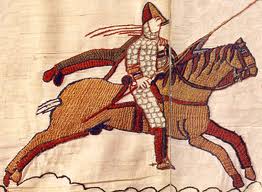
There are three main ‘eyewitness’ accounts of the Battle of Hastings- a short poem called Carmen de Hastingae Proelio (made as early as 1067), the Anglo Saxon Chronicle (9 manuscripts of year-by-year events kept at various monasteries across England), and the Bayeux Tapestry.  The Tapestry (which isn’t really a tapestry at all), was most likely finished by 1077, and is a goldmine of inadvertent information.  Commissioned by William’s half-brother Bishop Odo, it was intended to justify the Norman invasion while casting its two protagonists in a glowing, heroic light.  Unfortunately this bias at times compromises the larger credibility of the work.  For example, Harold’s coronation is shown being performed by Bishop Stigand, a man whose well-earned reputation for corruption had put a cloud over all of his dealings for years.  As an earl, Harold had refused to let Stigand consecrate any of his religious foundations, and it’s unlikely that he would have let the tainted clergyman anywhere near the royal ceremony.  His presence in the Tapestry is probably a none-too subtle Norman attempt to further discredit Harold.  There are other bias’ in the work as well.  Bishop Odo employed English artisans to execute the Tapestry, and there have been several books written about their subversive depictions of the Norman triumph.

But even with these reservations, the Tapestry remains a vital, eyewitness source for contemporary life and warfare in the 11th century.  In it we can glimpse the weapons, armor, styles of clothing, and even the pursuits of leisure in the vanished Norman and Anglo-Saxon worlds.

One response so far

What’s the best book about Belisarius?

Aug 03 2010

Listener Gary asks which of the few books on Belisarius are the best.  My favorite is the classic one by Lord Mahon (Philip Henry Stanhope) called ‘The Life of Belisarius’.  Originally published in 1829, it’s a bit outdated (it continues the myth of Belisarius’ blinding), but remains the standard if only for want of a serious rival.  If you prefer a more modern perspective there is Ian Hughes’ 2009 ‘Belisarius: The Last Roman General’, and if you don’t mind a touch of historical fiction, there is Robert Graves’ (author of ‘I Claudius’) very entertaining- and generally historically accurate- version called ‘Count Belisarius’.

One response so far

The last successful invasion?

Aug 02 2010

Listener David points out, ‘you called William’s conquest of England the last successful invasion of England by a foreign army.  Is that really the case?  Didn’t Frenchman Henry Plantagenet invade with local support and force King Stephen to name him as his successor?  Didn’t Welsh aristocrat Henry Tudor take the throne as Henry VIII with the help of Lancastrian allies?  And wasn’t the “Glorious Revolution” actually a successful Dutch invasion of England?  Isn’t it a double standard to categorize any successful invasion that has local support, as a civil war or a revolution instead of an invasion?’

David makes an excellent point here.  All of these examples are invasions and can quite rightly be called as such.  In each case non-English men seized power in England supplanting the previous dynasty.  So calling William the last successful invader is not technically correct.  I think there is a valid defense to be made, however, for distinguishing between these examples and what happened at Hastings in 1066.  It’s a double standard, but the term ‘invasion’ is usually reserved for a massive social upheaval where an ethnically or culturally different force displaces the native regime.  More than just a small change at the top (one related aristocrat for another) it’s a traumatic event that results in widespread effects at all social levels.  In that respect, William was the last of a series of invaders: Roman, Anglo-Saxon, Viking, and finally Norman.  No social upheaval quite so far-reaching has come at the hands of a foreign invader since.

One response so far

How did the once mighty Byzantine Navy decline?

Jul 30 2010

Reader Jeroen  asked what happened to the once mighty Byzantine navy that forced them to become so reliant on Genoese or Venetian sea power?

The Byzantine navy was in a way a victim of its own success- coupled with a complete lack of vision.  By the end of the Macedonian dynasty, it was the preeminent force in the eastern Mediterranean.  Major seaborne invasions were carried out against targets as far away as Sicily, and Sardinia, and the traditional naval powers of the Caliphate and the Russians were a receding threat.   The last serious Arab attack had come in 1035 and the last Russian one a decade later, and they both had been beaten back with ease.  There seemed no reason to pay for a huge navy with no one to fight, so Constantine IX (1042-55) had the fleet broken up into smaller units.  These detachments spent most of their time chasing after pirates, and quickly faded from the imperial attention.  Neglect and incompetence did the rest and by the end of the 11th century the fleet was in a deplorable position.  Other navies sprang up to fill the vacuum and the aging, ill-equipped Byzantines were routinely defeated by Turkish, Italian, and even Norman ships.  This humiliating state forced Alexius Comnenus (1081-1118) to sign an agreement with Venice exchanging trade concessions for naval support.  To his credit he recognized the danger and did his best to build up the imperial navy with the meager resources available.  By the time of his death he handed over a small but serviceable fleet to his successors, which was still strong enough to fend off the Venetians two decades later (at the steep cost of one of Enrico Dandolo’s eyes).

Alexius’ son and grandson, however, discovered that fleets are very expensive, and since they were more interested in land campaigns they transferred most of the funding to the army.  The next dynasty (Angelus 1185-1204) was a good deal worse, dropping even the pretense of upkeep.  They depended on trade concessions with Sicily, Venice, and Genoa to keep their coasts secure, and concentrated on having a good time.  One particularly pathetic emperor (Alexius III Angelus) even allowed one of his generals to sell off the warships for personal profit, virtually abolishing the navy.  By the time of the 4th Crusade there were only 20 ships left, 3 of which were seaworthy.  The other 17 were loaded down with Greek Fire and pushed in the direction of the Crusader’s navy.  Basil II must have been spinning in his grave.

One response so far

Who were the Varangians?

Jul 20 2010

Listener William asked who the Varangians were and why they figured so prominently in Byzantine military affairs. 

The Varangians were the elite forces of the Byzantine army- much like the Praetorian Guard of ancient Rome or the Ottoman Janissaries.  They were originally made up exclusively of Vikings (which the empire had been hiring as mercenaries since the 9th century), but after the Norman Conquest of England a rush of exiled Anglo-Saxons were added to the mix.  By the 12th century there were so many English that it was commonly being referred to as the ‘Anglo-Varangian’ Guard.  As the empire declined, the Varangians also fell on hard times.  By the middle of the 14th century they had largely ceased to function and the last mention of them is in the first decade of the 15th century. 

They appeared relatively late in Byzantine history.  In 988, the emperor Basil II, facing a serious revolt, asked the Viking prince of Kiev for some help.  In exchange for an imperial bride, the prince sent along 6,000 warriors and Basil was so pleased by their effectiveness that he made them his permanent bodyguard.  Their oaths were to him personally- a fact that the court was uncomfortably aware of- and they were housed in the Bucoleon Palace where they could keep an eye on things.  Basil made sure they were given a generous salary and he called them ‘Varangians’- literally ‘men of the pledge’. 

Since they were professional fighters they were the most valuable troops in an army made up mostly of mercenaries or levies.  Usually taller and fiercer than their Mediterranean hosts/opponents, they also made good use as propaganda tools to overawe rebellious subjects or frighten opposing armies.  In times of peace they could act as a police force in Constantinople or for ceremonial functions.  In war they were usually held in reserve until the critical phase of the battle- then sent where the fighting was thickest.  Even the Byzantines seem to have been slightly terrified of their berserker rages. 

The opportunities for wealth ensured a steady stream of recruits, and few returned home empty-handed.  At the death of an emperor they had the curious right to raid the treasury and take away whatever they could carry unassisted.  Perhaps because of this they gained a reputation for fierce loyalty to the office- but not necessarily the occupant- of the throne. 

At times the temptations of power were too much to resist and they would lord it over the population of Constantinople- usually in the local wine shops.  Their drinking bouts were almost as legendary as their fighting skills and a visiting Danish king in the 11th century was embarrassed enough to publicly lecture them about their behavior. 

His words do not appear to have had the desired effect.  A century later some brave soul referred to the Varangians as the ‘Emperor’s wine-bags’.

One response so far

Did Justinian have Belisarius blinded?

Jul 14 2010

Reader Bryan asked what I thought of the legend that Belisarius was blinded by Justinian.  According to the story, a jealous and fearful Justinian arrested Belisarius after his final victory and had him tried for treason.  The loyal general’s eyes were put out, his estates confiscated, and he was forced to wander the streets of Constantinople begging for bread while contemplating the vicissitudes of fortune.

Belisarius did briefly fall out of favor late in Justinian’s reign, but was publicly rehabilitated.  The story of his blinding originated in the 12th century with the monk John Tzetzes who was trying to criticize the political figures of his own day.  It made for a good morality tale, and was pressed into service in the 18th century by Europeans (mostly French) who saw a parallel between the tyranny of Justinian and their own autocratic societies. (see the spectacular painting by Jacques-Louis David and the play ‘Bélisaire’ by Jean-François Marmontel)

Some scholars still argue that the legend does have some basis in fact (Justinian was certainly capable of it), but there are several reasons not to accept it.  The Crusaders who sacked Constantinople in 1204 mentioned several large statues of Belisarius still standing.  Had he been blinded and disgraced these surely would have been torn down.  Along the same lines there was also a great cycle of mosaics detailing the victories of Justinian and Belisarius above the gate to the imperial palace.  These were made during Justinian’s lifetime and were still in place a thousand years later.  Finally, there are the writings of the contemporary historian Procopius.  In his ‘Secret History’ he makes no mention of the emperor humiliating his general, despite the fact that he clearly hated Justinian and was trying to blacken his name.  He accuses Justinian of being a devil in the shape of a man, of being responsible for the deaths of a trillion people, and of having a head that would routinely disappear- but not of harming Belisarius.

Nevertheless the legend persists- perhaps because its lesson still resonates.  As Henry Wadsworth Longfellow summed it up neatly in his poem about the great general:

“Ah! Vainest of all things

Is the gratitude of kings.”

2 responses so far

What if Urban had built his super cannon for the Byzantines?

Jul 12 2010

Reader Patricia asks if the Byzantine defeat in 1453 can really be blamed on ‘modern weapons’ since the Byzantines also had access to them.  Was it really a matter of simply not having enough money to build them?

I think the Ottomans would have eventually been able to take the city in any case.  It was far too exposed, depopulated, completely cut off from friendly Christian powers, and vastly outnumbered.  But for all that, it still took 48 days of continuous bombardment.  Given the tensions within the Ottoman army and the loss of face associated with each unsuccessful day, would Mehmed have been able to maintain discipline and morale if he had to wait on traditional siege machines?  There were already serious challenges to his authority brewing by the time he broke in- and that was with the aid of ‘super’ weapons that could punch their way through walls. Constantine XI was fully capable of rallying his troops and did quite well with his limited forces.  It’s always dangerous to speculate but I think he could have held the city against one or two standard Ottoman attempts.

So firepower was clearly important, but as Patricia correctly pointed out, it wasn’t just a simple matter of technology.  The Byzantines actually did have a few guns- though they were smaller than the Ottoman’s and frequently damaged their own walls with the recoil.  What they really lacked was the infrastructure needed to sustain the technology.  Enough money couldn’t be scraped up to retain Urban much less pay for the powder, projectiles, and the specialists needed to fire and repair them.  The Ottomans could afford to fully integrate massive new cannons into their army; for the impoverished Byzantines- even if Urban had built his great gun for free- they had to remain a curiosity.

3 responses so far

Was Tostig a hero- or a villain?

Jun 26 2010

Listener Pete asks if Tostig Godwinson should be considered a heroic figure.  It’s somewhat hard to get a fair picture of Tostig because unlike the other principle figures of 1066, he lacks a chronicle written from his perspective.  He ended up on the wrong side in every respect- to the English he was a traitor, to the Normans he was irrelevant, and to the Norse he was merely a means to an end- a despicable figure who had sold out his own brother.   But Tostig was clearly a man of many abilities- a fact which is frequently ignored.  As the third son of Earl Godwin, he was always a bit overshadowed by his older brother Harold, but he obviously had the family knack for politics.  His father secured him an influential marriage with the daughter of the Count of Flanders, and he quickly ingratiated himself at the English court.  Thanks to his considerable charm he became the favorite brother of Queen Edith and so impressed King Edward that he was appointed Earl of Northumbria at the relatively young age of 30.  This was a difficult assignment for many reasons.  Northumbria was a mess, a wild place controlled by outlaws where the earl’s authority seldom went further than the outer wall of his household.  The population was a mix of Danish and English who actively resisted outside control and did their best to continue the chaos.

Tostig- who was half Danish himself- attacked the problem vigorously and within five years had cleaned up the earldom, arresting the cutthroats and firmly imposing his control.  But just as he appeared ready to eclipse his brother everything started to go wrong.  His mixed blood should have endeared him to his subjects, but as a southerner he was deeply resented and his habit of using Danish mercenaries as personal guards further alienated him.  His firm rule, at first so necessary to enforce order only got harsher as his hired thugs extorted ever-higher taxes.   Even worse, he began to show signs of irrational behavior.  Any questioning of his authority met with excessive brutality.  Two of his most important thegns that he suspected of insubordination were lured to a meeting and executed, and a third was assassinated.  This was a wild violation of English law- one of an earl’s responsibilities was to protect his thegns not murder them.  The resulting uproar led to Tostig’s banishment, a fate from which even the king couldn’t save him.

Tostig could have faced his exile stoically.  He had family in Flanders and could have lived out his life in wealth and comfort.  Instead he publicly accused Harold of fomenting the rebellion in his earldom, and left swearing revenge.  The result was the death of his allies, himself, and eventually the overthrow of the English kingdom along with what was left of his family.  However talented he was to start, Tostig ended as a rather tragic and pathetic figure, wandering around northern Europe begging for help, turned down by everyone he met except the bored Hardrada.

There was at least some redemption for his family.  His son Skuli Tostisson Kongsfostre fled to Norway, and his offspring insinuated themselves into the Danish royal family.  The current monarch Margrethe II is therefore a distant descendant of Tostig Godwinson.

No responses yet

Older »